
Author: Lars Petrova Taylor (Fab City Foundation, GreenInCities)
Contributors: Giuseppe Ciulla, Lina Morkūnaitė, Svetlana Khromova, Dirk Ahlers, Evelina Faliagka, Haris Piplas,Carlos Miranda-Garrote, Jérémy Wautelet, Laura Angélica Valadez Rojas, Susana Scott Ayala
Introduction
Cities today are under increasing pressure to respond to climate change, biodiversity loss, and social inequality, while also involving citizens more directly in shaping urban futures. Digital tools and nature-based solutions are often presented as skey enablers of this transition. However, as highlighted in the “Tech for All: Driving Inclusivity in Nature-Based Solutions to Improve Societal Readiness Levels” webinar, technology alone does not create inclusive cities. What matters is how it connects with people and the places they inhabit.
This article summarises key insights from the webinar that brought together researchers, practitioners, and city representatives from several international projects to explore how technology can support more inclusive and participatory urban transformation.
Organised by Fab City within the GreenInCities project, the event featured contributions from sister projects including URBREATH, ReGreeneration, ClimaGen, Commit2Green, and from the Fab City Challenge, Tecnológico de Monterrey. The discussion brought together perspectives from multiple European and international projects to reflect on a central question: how can participatory processes move beyond consultation towards meaningful, visible change? Three interconnected dimensions emerged as critical technology, inhabitants, and place, each shaping how inclusive urban transformation can be realised in practice.
Technology: making participation visible and meaningful
Digital platforms are now widely used by cities to collect citizen input, visualise projects, and support decision-making. Yet many of these tools struggle to sustain engagement. A recurring issue is not a lack of participation, but a lack of visibility, in particular with the language gap between municipalities and citizens. Citizens are often asked to contribute ideas or feedback but rarely see how their input influences real outcomes. Over time, this disconnect erodes trust and creates the impression that participation is symbolic rather than impactful.
Examples from practice show that technology can play a much stronger role when it closes this gap between input and action. In the GreenInCities project, architecture students working on real urban sites developed nature-based proposals that were integrated into a digital twin of the city. This allowed stakeholders to explore ideas spatially, seeing how interventions would actually appear and function in their environment. Rather than abstract plans, proposals became tangible and discussable, helping bridge the gap between technical design and public understanding.
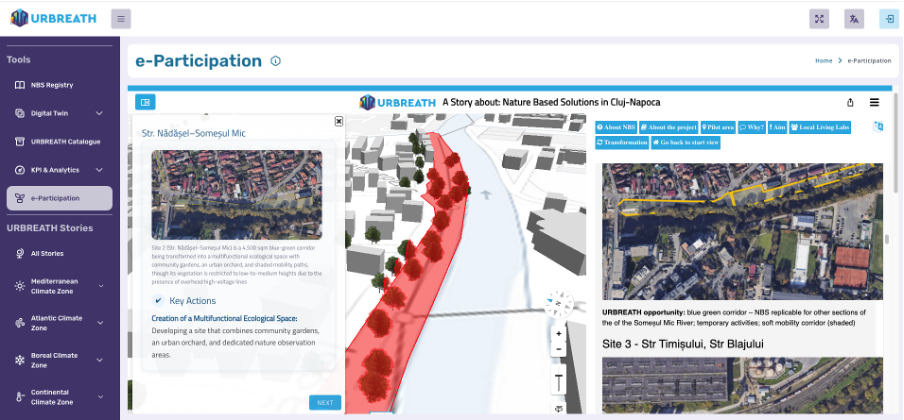
Similarly, approaches developed in URBREATH demonstrate how combining data with storytelling can make complex information more accessible. By embedding 3D visualisations, environmental data, and multimedia content into coherent narratives these tools allow users to explore projects at their own pace rather than passively receiving technical information. This shift from presenting data to guiding experiences, makes it easier for people to identify issues, form opinions, and contribute meaningfully.
For practitioners, the lesson is clear: technology should not simply collect feedback, but actively demonstrate its consequences. This requires designing platforms that are transparent, intuitive, and responsive. While also acknowledging that not all users have the same level of digital literacy. When tools are inclusive and outcomes are visible, technology can strengthen trust and make participation feel worthwhile.
Inhabitants: from engagement to shared ownership
If technology provides the tools, it is communities that determine whether participation succeeds. Engaging inhabitants in urban transformation is not simply a matter of inviting them to workshops or opening online consultations. It requires building trust, creating relevance, and recognising the diversity of people who make up a city.
One of the clearest insights from the discussion is that open calls alone are rarely sufficient. They tend to reach those who are already engaged, while overlooking groups who are less visible or face barriers to participation. More inclusive approaches rely on working through trusted local networks such as schools, community organisations, or grassroots initiatives, that already have established relationships with residents.
This was evident in the GreenInCities pilot in Athens, where engagement activities were developed in close collaboration with schools, parents’ associations, and local organisations. By working through these networks, the project was able to involve children, caregivers, and older resident groups that are often underrepresented in planning processes. The resulting co-design workshops generated proposals rooted in everyday experience, such as improving pedestrian areas or creating small biodiversity spaces within neighbourhoods. These outcomes illustrate how participation becomes more meaningful when it reflects the lived realities of those involved.
At the same time, participation must go beyond one-off engagement. Projects that succeed in the long term are those that create a sense of ownership, allowing communities to shape, adapt, and sustain interventions over time. The Fab City Challenge in Mexico offers a compelling example, where local organisations were not only consulted but actively involved in the design and evolution of a mobile environmental platform. By embedding learning and collaboration into the project itself, the initiative created conditions for ongoing participation rather than temporary involvement.
For those designing participatory processes, this highlights the importance of shifting from engagement to co-creation. When people see their knowledge reflected in outcomes and feel responsible for maintaining them, participation becomes a continuous and self-sustaining process rather than a single event.
Place: grounding participation in everyday environments
While digital tools and community processes are essential, participation ultimately takes shape in physical space. Streets, parks, and neighbourhoods are where urban change becomes visible, experienced, and contested. As such, place is not simply a backdrop for participation, it is an active component of it.
Public spaces, in particular, play a crucial role as accessible and democratic environments where different groups can come together. They provide opportunities for informal interaction, experimentation, and dialogue that cannot be fully replicated in digital environments. Integrating participatory activities into these spaces helps make processes more inclusive, especially for those who may not engage with online platforms.
At the same time, data-driven approaches can support these processes when used appropriately. Projects such as ClimaGen demonstrate how existing datasets and mapping tools can be used to identify opportunities for urban greening and climate adaptation, while also serving as a starting point for discussions with residents. Rather than presenting data as fixed or authoritative, these tools can open up conversations about local priorities, trade-offs, and possibilities.
However, the discussion also highlighted that data is often incomplete, uneven, or difficult to interpret. Waiting for perfect information can delay action unnecessarily. Instead, practitioners are encouraged to work with available data, using it as a basis for engagement while remaining attentive to local knowledge and context. Ultimately, successful participatory processes are those that balance digital and physical interaction. Technology can support analysis and visualisation, but it is through face-to-face encounters and shared experiences that trust is built and ideas are negotiated. Designing for inclusion therefore means considering both the accessibility of tools and the accessibility of spaces.
Expanding participation beyond the human
An important reflection emerging from the discussion concerns the limits of current participatory approaches. Even when processes are inclusive of diverse social groups, they tend to remain human-centred. Yet urban transformations also affect ecosystems, biodiversity, and non-human life.
Recognising this gap invites a broader understanding of participation, one that considers how ecological perspectives can be represented within decision-making processes. Whether through data, environmental indicators, or advocacy, integrating the needs of non-human actors is essential for truly sustainable urban development.
Key Take aways
The discussions made clear that inclusive urban transformation cannot be achieved through technology, participation, or design alone. It emerges from the interaction between all three. Digital tools must be transparent and accessible, communities must feel a genuine sense of ownership, and public spaces must enable meaningful encounters.
Perhaps most importantly, success should not be measured by the number of participants or the sophistication of the technology used, but by whether these processes lead to tangible improvements in everyday life. When people can see and experience the results of their contributions, participation becomes not only more effective, but more meaningful.
This is part one of a series of webinars that will contribute together to a final output in terms of a policy brief or potential paper collecting the learnings from a diverse range of topics.