
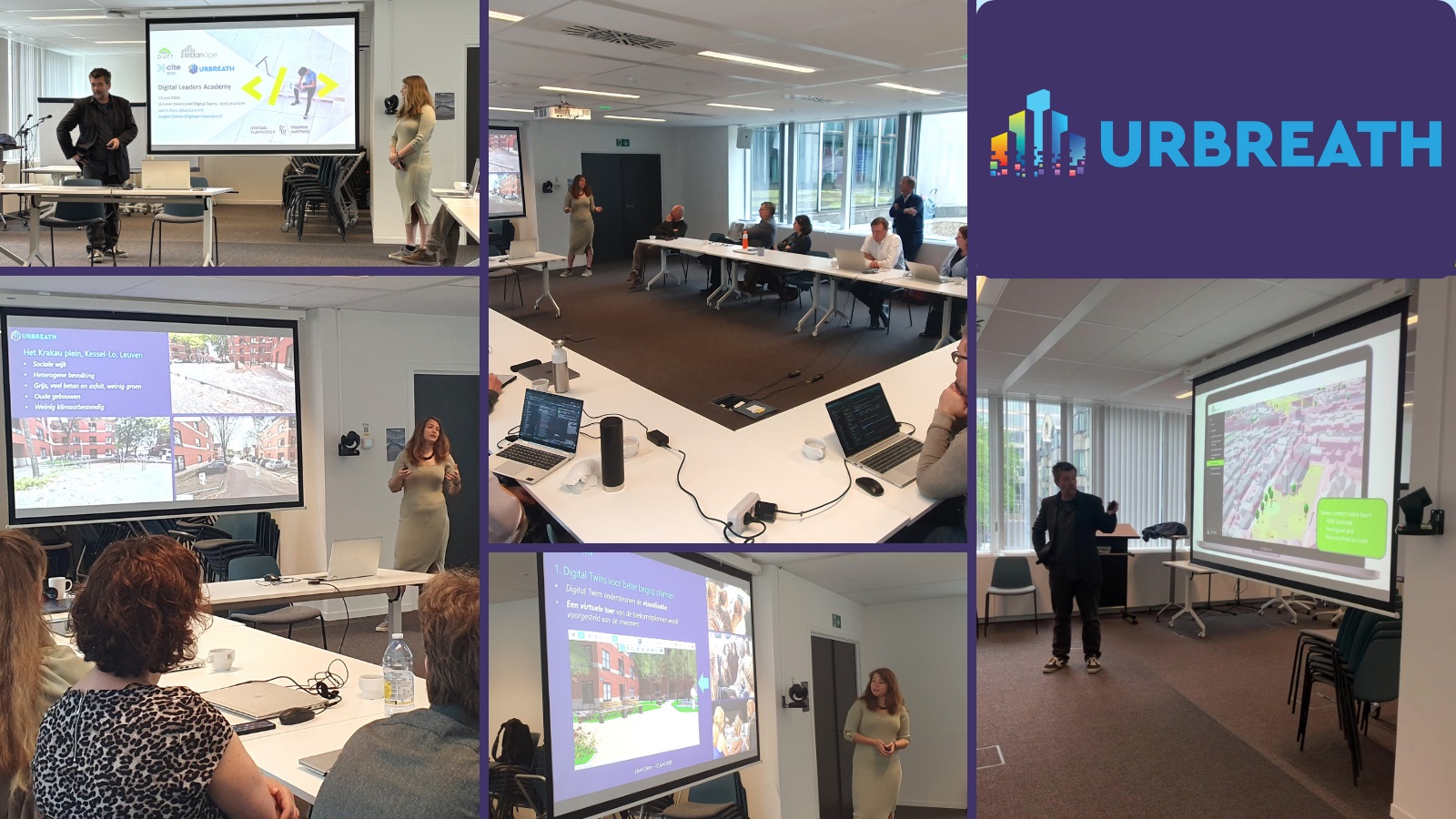
On Friday 12 June, Jurgen Silence (Digital Flanders) and Laura Dens (City of Leuven) presented the URBREATH project at the Digital Leaders Academy (DLA). Their presentation introduced the project in general and explored the development and use of Digital Twins in various EU projects and locations, including Leuven.
The DLA is a learning and networking programme by Digitaal Vlaanderen that aims to strengthen digital leadership across Flemish and local government. It brings together managers, policy makers, leading civil servants and digital frontrunners to explore how data, AI and Digital Twins can support smarter, more user-centred public services.
The 12 June DLA session, titled “Smarter policy making with Digital Twins”, took place in the Conscience building in Brussels and focused on practical best practices for using Digital Twins in policy making. In their duo presentation, Jurgen and Laura showed how Digital Twin technology can support smarter decisions, stronger visual storytelling and more targeted climate adaptation measures in cities such as Leuven.
The presentation highlighted different aspects of the Digital Twin approach: how traffic, air quality and noise models can be integrated into large-scale projects such as DUET; how Digital Twins can be co-created and customised for specific target groups, as in the URBANAGE project; and how Digital Twins can be tailored to a specific purpose, such as the design and implementation of Nature-Based Solutions (NBSs) in the URBREATH project.
For Leuven, the presentation demonstrated how Digital Twins can be implemented to create simulations and stunning visualisations of future NBS deployments within the framework of Living Lab storytelling. It also showed their potential as a powerful tool for making evidence-based decisions on the NBS setup, using a variety of dynamic models such as 3-30-300 and BAF maps, and for following up KPI-based NBS effects on site, including heat stress and flooding maps, various climate resilience monitoring tools, shadow impact measurements, tree growth simulations and the visualisation of sensor data.
Overall, the DLA session was both highly interesting and a clear success, offering a valuable opportunity to exchange ideas on the role of Digital Twins in smarter policy making. We warmly thank the organisers for the invitation and for giving us the opportunity to pitch URBREATH to such an engaged audience.