
By Jurgen Silence, Digital Flanders
Edited for publication by the URBREATH team
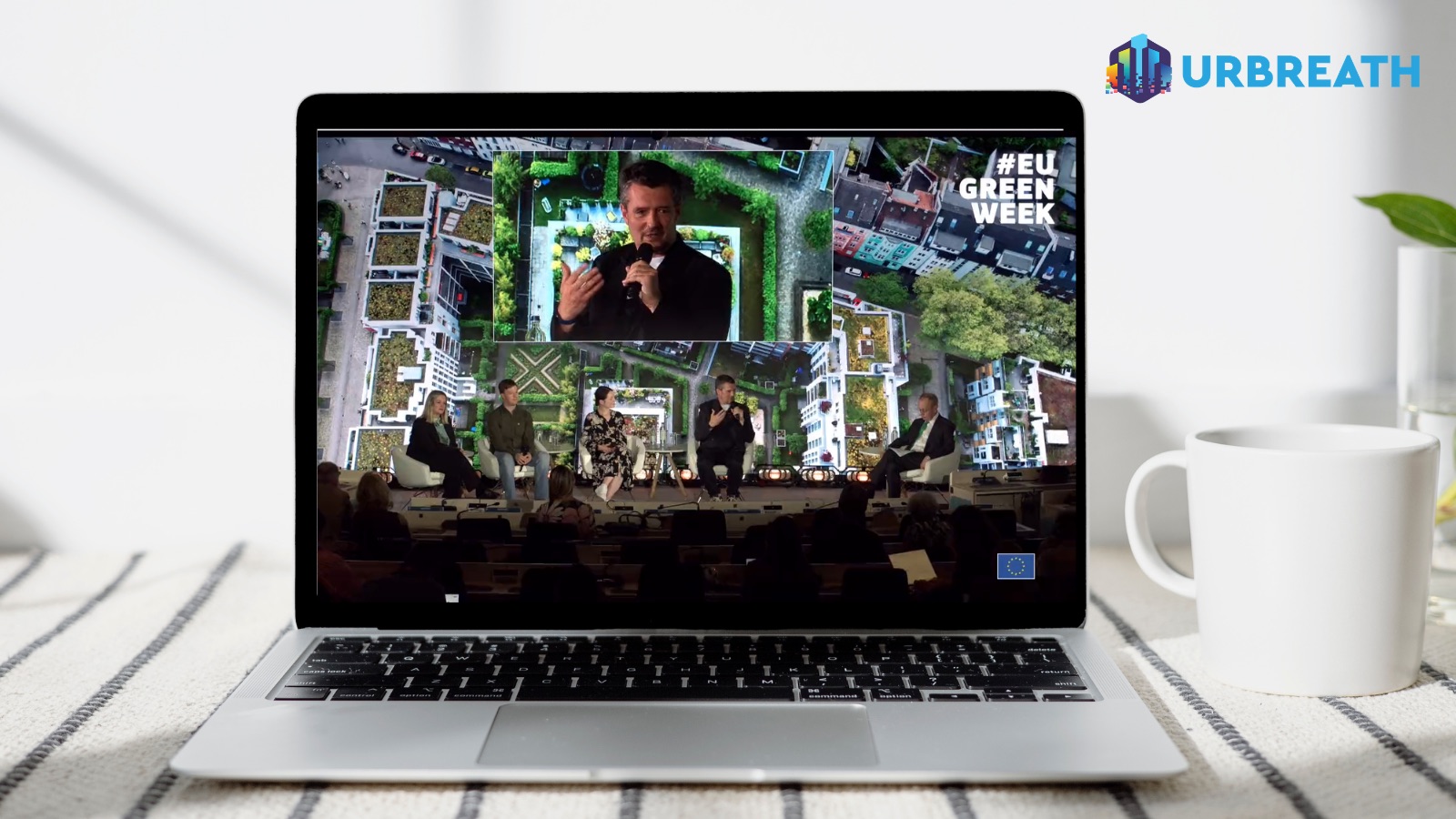
On 4 June, Jurgen Silence, senior project manager at Digital Flanders, represented the URBREATH project at EU Green Week, held in the Charlemagne building in Brussels.
EU Green Week, which took place on 3 and 4 June, is Europe’s leading annual conference on environmental policy. Organised by the European Commission’s Directorate-General for Environment, it provides a platform to raise awareness, exchange knowledge and discuss the latest developments in EU environmental action. The event brings together policymakers, businesses, environmental experts, researchers, civil society organisations, local and regional authorities, and other stakeholders from across Europe and beyond.
As part of the programme, the panel “Can urban greening and urban development go hand-in-hand?” explored how cities can continue to grow while becoming greener, healthier and more climate-resilient. Moderated by Patrick Child, Deputy Director-General of DG Environment, the discussion addressed a central urban challenge: as more Europeans live in cities, urban areas must provide affordable housing, infrastructure and economic opportunities while also restoring nature, improving quality of life and adapting to climate change. Patrick framed urban greening not as an optional extra, but as a core part of the EU’s environmental and climate agenda, connected to initiatives such as the European Green Capital, the Green City Accord, the Cities Mission and the Nature Restoration Regulation.
Jurgen Silence highlighted the practical link between technological innovation, meaningful stakeholder participation, and the design, implementation and monitoring of nature-based solutions (NBS). Drawing on a Living Lab example from Leuven, he explained how citizens in a dense, grey and climate-vulnerable neighbourhood were invited to co-create NBS for their own living environment. Their ideas were then translated into several digital twin scenarios, enabling residents to interactively explore future interventions such as trees, wadis, benches and recreational elements in their neighbourhood. For Jurgen, the value of the digital twin goes beyond technology: it shows people that their ideas are taken seriously, makes future possibilities tangible, and builds enthusiasm and ownership before implementation begins.
A key point in Jurgen’s intervention was that digital tools should support, not replace, local knowledge. He described the URBREATH digital twin as a holistic tool that brings together multiple layers of information, including 3D maps, soil and biotope indicators, heat, flooding and drought models, climate resilience indicators, dynamic 3-30-300 maps, tree growth simulations, shadow simulations, sensor data, traffic information, air quality data and noise monitoring. This combination helps planners and urban designers assess which nature-based solutions are most suitable for a specific location, where trees should be placed, whether water-retention measures are needed, and how interventions may affect mobility, comfort and other local conditions. The URBREATH Toolbox is also designed to work across different European climatic zones, recognising that challenges in northern cities may differ from those in southern cities.
At the same time, Jurgen stressed that models alone are not enough. Living Labs are essential for bringing together diverse groups of stakeholders and capturing lived experience that data alone cannot provide. Older residents can explain how an area has changed over time and which solutions may have failed in the past; younger people can describe how spaces are used today; people with disabilities can highlight accessibility needs; and residents from different cultural backgrounds can bring new perspectives. This inclusive approach can also reveal important concerns, such as safety, for example where dense planting may be unsuitable if visibility is important. In this way, co-creation improves both the quality and the acceptance of urban greening interventions.
Jurgen suggests that scaling support for urban greening does not necessarily require expensive solutions, but rather strong and inclusive participation processes. He emphasises the importance of bringing people together, including harder-to-reach or less motivated groups, and engaging them through dialogue, inspiration, and constructive challenge. To make this effective, he stresses the need for careful preparation, learning from existing best practices, involving all relevant stakeholders, and building local capacity through approaches such as train-the-trainer sessions, as done in URBREATH with the pilot cities. For digital tools, he proposes keeping solutions accessible and affordable by avoiding overly complex or costly systems where possible, using modular “digital twin as a service” options, collaborating across departments, purchasing only the necessary components, and sharing costs.
Bert Belmans, Professor at VUB, Research Coordinator at the University of Antwerp, and Global President of WGIN CEP, argued that “green versus grey” is a false dilemma. Cities should combine green and grey infrastructure, make better use of building surfaces such as roofs and façades, and apply the right solution in the right place. He also underlined the need for decision-support frameworks that quantify not only direct costs, but also co-benefits such as cooling, acoustic performance, health benefits and reduced long-term risks.
Irina Spacova, Assistant Professor at the Department of Bioscience Engineering at the University of Antwerp, brought in the public health perspective. She explained that urban green spaces support physical and mental health, help reduce pollution, strengthen immune systems through microbial exposure, and are especially important for people without access to private gardens or large forests. Her research on green schoolyards showed that biodiversity in urban playgrounds can generate measurable health benefits, particularly in urban and lower socioeconomic contexts.
Dalila Sepúlveda, Head of the Department of Environment and Sustainability at the Municipality of Guimarães, shared the city’s experience as European Green Capital 2026. She showed how long-term political consensus, science-based decision-making and civic pride can make urban greening part of a city’s identity. She highlighted river greenways, free public transport, co-created schoolyards and neighbourhood work in social housing as examples of how citizens can see greening reflected in their daily lives.
Overall, the panel showed that successful urban greening requires political commitment, strong evidence, measurable co-benefits, accessible tools and genuine public involvement. The URBREATH Toolbox and Living Labs can help connect these elements by making future scenarios visible, supporting better professional decision-making, and giving citizens confidence that they are not only being consulted, but are actively helping to shape greener and more resilient cities.
The recording of the Green Week session “Can urban greening and urban development go hand-in-hand?” is available here. To go directly to the panel discussion, click the session title below the video.
Many thanks to EU Environment and Climate and Barbara Piotrowska for the kind invitation and inspiring discussions.