
Part 1: Living Lab context and focus actions for FRC Cluj-Napoca
Cluj-Napoca has adopted a city-wide strategy centred on urban greening, with a strong emphasis on reinforcing the Someș river axis running from east to west. This vision has been supported by a series of medium- and large-scale green infrastructure projects, many initiated through international design competitions that have acted as catalysts for urban innovation and expertise.
While this approach delivers significant impact at scale, it tends to overlook small, interstitial green spaces dispersed throughout the city. These include roundabouts, residual plots, and spaces between collective housing blocks. Although too small to justify major financial investments, such areas play a critical role in shaping everyday urban experience and the perceived quality of the urban landscape.
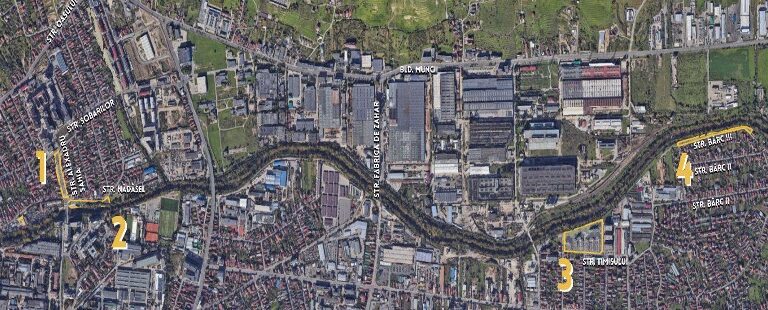
The four sites selected for NBS implementation within URBREATH—Alexandru Sahia, Nădășel, Timișului, and Barc III—belong precisely to this category. Ranging from under 5,000 m² to over 8,000 m², they are small to medium in size and share a common characteristic: direct adjacency to the Someș river. This positioning gives them strong potential to support the development of a continuous blue-green corridor. Despite existing vegetation, all four sites are currently underused, functioning mainly as transit spaces or remaining largely neglected.
By intervening in these small-scale sites through Nature-Based Solutions, Cluj-Napoca aims to improve local quality of life by enhancing the urban landscape and fostering community use. These interventions create accessible spaces for leisure, social interaction, and everyday enjoyment. At the same time, their low cost and simplified administrative requirements make them highly replicable, offering a complementary pathway to large infrastructure projects. In this way, NBS can help stitch together a coherent network of green spaces along the Someș river, reinforcing the Someș Masterplan and providing tangible, transferable examples for future implementation.
Part 2: From ideation to action – the co-creation process in IRIS and Someșeni
The Cluj-Napoca Living Lab follows a co-creation model grounded in small-scale, replicable actions along the Someș blue-green corridor, implemented across the four pilot sites. The process combined site observations, co-design workshops with residents, dialogue with local stakeholders, and student-led design proposals, resulting in NBS concepts tailored to local ecological and social conditions.
(See NBS Registry: https://dashboard-dev.urbreath.tech/tools/nbs-registry)
The proposed solutions focus on strengthening blue-green connectivity, increasing biodiversity, and improving the everyday usability of underutilized green spaces through multifunctional, ecosystem-based interventions aligned with NBS registry principles. Four site-specific approaches were developed:
- Alexandru Sahia – “The Narrow Forest”: a green buffer improving pedestrian safety while mitigating heat island effects and traffic-related pollution.
- The intervention reinterprets the existing central vegetated strip as a linear “narrow forest” that separates pedestrian movement from intensive car traffic and reinforces the identity of the residential street.
- The NBS approach focuses on strengthening green infrastructure through dense, layered, and low-maintenance vegetation adapted to heavy traffic conditions. By consolidating fragmented green areas into a continuous corridor, the intervention improves microclimatic comfort, reduces exposure to traffic-related pollution, enhances ecological connectivity, and encourages everyday walking and social interaction within the neighborhood.
- Nădășel – “The Meadow and the River”: a blue-green corridor with open meadows, pollinator-friendly planting, and multifunctional community space.
- The intervention reshapes the relationship between the Someș River and the surrounding open space, creating a continuous and accessible landscape while preserving the natural character of the riverbank.
- The NBS approach prioritizes low-impact, ecosystem-based measures based on native and pollinator-friendly species adapted to floodplain conditions and existing infrastructure constraints. Open meadow structures and strengthened riparian vegetation support biodiversity and ecological connectivity along the river corridor, while allowing flexible social and recreational activities within a resilient blue-green system.
- Timișului – “The Village Hearth”: an ecological corridor and open meadow designed for community activities and urban gardening.
- The intervention builds on existing informal uses and reinterprets the open space as a place for everyday social interaction, reinforcing the relationship between nature, community life, and broader blue-green corridor.
- The NBS approach emphasizes low-maintenance, nature-based elements that support both ecological functions and social use. Native vegetation, open meadow areas, and community gardening spaces enhance biodiversity and ecological continuity, while providing flexible settings for recreation and collective activities. Through this balanced integration, the site strengthens social cohesion and promotes long-term community engagement within a resilient green infrastructure network.
- Barc III – “The Orchard”: a green corridor featuring mixed fruit trees for shared community use.
- The intervention builds on the site’s proximity to the river and its existing green character, transforming an underused area into a multifunctional landscape that supports everyday community use while maintaining ecological functions.
- The NBS approach combines productive landscape elements with ecological restoration through locally adapted vegetation that improves microclimatic comfort, enhances biodiversity, and strengthens blue–green connectivity along the Someș River. By prioritizing accessibility, flexible open spaces, and shared stewardship, the intervention supports long-term community engagement and reinforces the role of the site as an integral element of the local green infrastructure.
Implementation followed a low-resource, strategic “guerrilla urbanism” approach, translating co-designed concepts into concrete on-site actions. Stage 1 was completed in December 2025, with Stage 2 planned for May 2026. Following a creative competition involving students from USAMV Cluj-Napoca, over 40 students worked alongside the Municipality of Cluj-Napoca, the Green Spaces Department, and technical teams to implement the winning proposal developed by the Sătenii team. This resulted in the planting of more than 1,600 understory plants (shrubs, grasses, and perennials) and 129 trees.
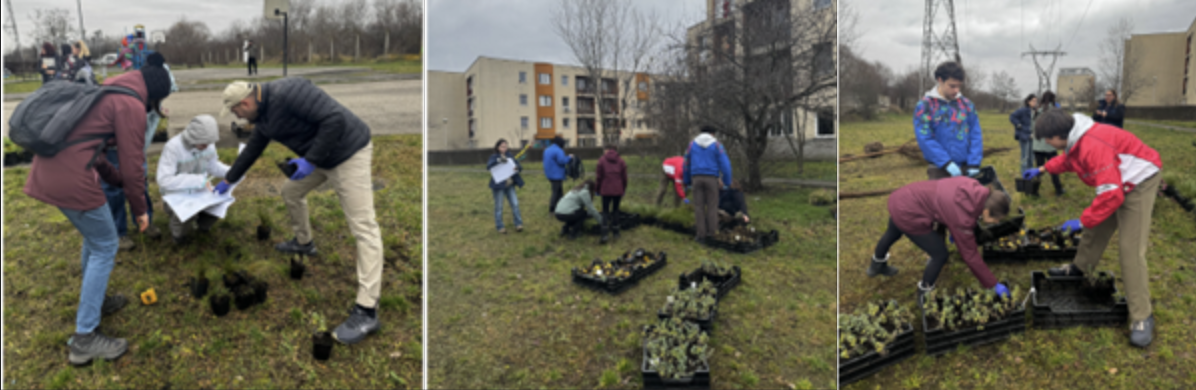
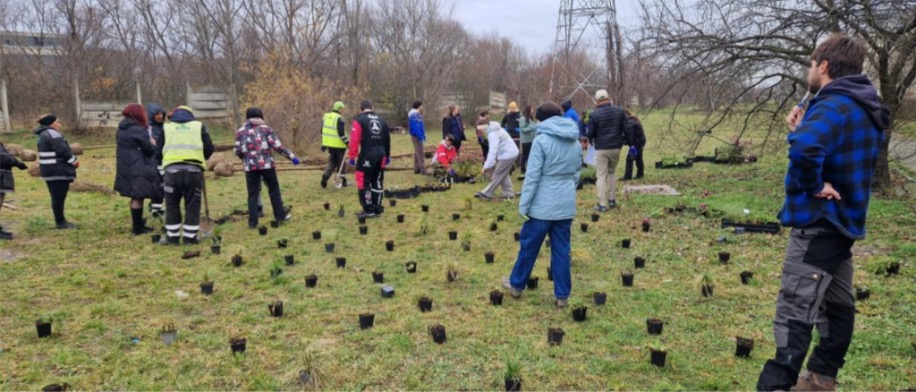
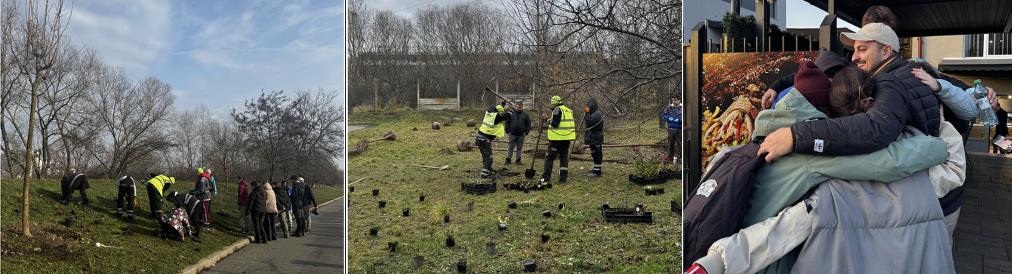
The four sites acted as complementary testing environments, allowing calibration of interventions, adaptation to local conditions, and coordination across fragmented urban spaces. The planting days also functioned as moments of direct collaboration and on-site learning.
The insights gained will inform the next project stages, including research activities, the URBREATH Digital Twin, and the design of urban furniture planned for spring 2026. In Cluj-Napoca, this Living Lab demonstrates that urban transformation begins not with technology or indicators, but with people, real places, and a shared willingness to experiment with new ways of working with nature.
Part 3: Project focus – adapting NBS to small, degraded, and fragmented green areas
URBREATH focuses on adapting Nature-Based Solutions to small, degraded, and fragmented green areas that are typically excluded from large-scale urban regeneration efforts. The Living Lab prioritises simple, modular, and low-cost interventions, including biodiverse planting, temporary structures, and multifunctional open spaces, all tailored to local ecological and social contexts.
High replicability is ensured through adaptable design principles, use of local materials, and limited technical complexity. This allows solutions to be easily transferred to similar sites across other neighbourhoods and along the wider metropolitan corridor.
At city scale, the URBREATH Living Lab aims to establish a best-practice model and a compelling narrative that inspires local communities and institutions to replicate these approaches across multiple small and neglected sites. The formula is intentionally simple: low-cost, modular interventions; biodiverse planting; temporary elements; and strong community involvement.
Part 4: Testing and integrating digital tools
Several digital tools have been developed and tested within URBREATH and are already being applied in Cluj-Napoca. Central among these is the Digital Twin, in which all four NBS sites have been modelled, including surface types, vegetation layers (tall, medium, and low), and future urban furniture and points of interest. The tool enables analyses such as sunlight exposure, Biotope Area Factor (BAF), and vegetation-related water consumption.
Complementing this, the e-participation tool facilitates structured communication with residents, supporting co-creation through transparent information sharing and systematic feedback collection.
To further anchor NBS in urban planning practice, URBREATH also includes an NBS Registry documenting all developed solutions. The four Cluj sites are presented through baseline photographs, site descriptions, objectives, and implementation details, supporting transparency, learning, and replication.
Part 5: Relevant connections with local initiatives
URBREATH’s Living Lab activities are closely linked to existing local initiatives that support the broader uptake of Nature-Based Solutions. A key output is the development of an NBS whitepaper addressing green procurement processes. Based on interviews with public authorities, private companies, NGOs, and urban professionals, the whitepaper highlights challenges related to long-term costs, maintenance, material selection, and sustainability standards, and translates them into practical, life-cycle–oriented guidance.
The project also aligns with Cluj-Napoca’s “Adopt a Green Space” programme, which enables public and private actors to take responsibility for small green areas through public–private partnerships. URBREATH strengthens this mechanism by shifting the focus from purely aesthetic landscaping to data-informed NBS interventions, using digital tools to match sites with appropriate NBS typologies and clear environmental objectives.
Finally, the pilot interventions along the Someș blue-green corridor function as visible, inspirational examples of how neglected spaces can be transformed through low-cost, community-driven action. By demonstrating concrete environmental and social benefits, URBREATH supports replication across other neighbourhoods and contributes to building a shared culture of care for greener, healthier urban environments.
Pilsen: The Square of the Republic in Pilsen is a central and vital part of the city. The goal of its revitalization is to enhance the comfort and safety for pedestrians and cyclists, improve public transport flow and speed, enhance rainwater retention, and elevate the residential quality and safety perception.
The planned Nature-Based Solutions focus on introducing greenery and sustainable water management into the historic square. A grid of trees will be planted to provide shading, reduce surface temperatures, and improve air quality. The new trees are designed to integrate harmoniously with the existing urban layout and architectural heritage.
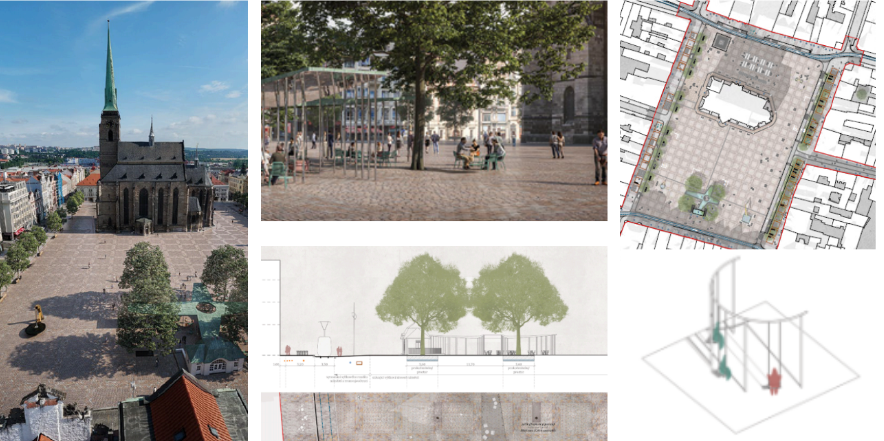
In addition, the design includes permeable paving and underground systems for rainwater infiltration and retention, helping to reduce runoff during heavy rainfall. Together, these measures will enhance microclimate regulation, increase biodiversity, and strengthen the square’s resilience to heat and flooding, while preserving its cultural and social value as Pilsen’s central public space.