
Demonstration of the multi-dimensional value of collaboratively greening the regeneration of a public square with historical buildings within the Atlantic climate zone.
City of Leuven: The Krakau square is located on the outside of Leuven’s ring, forming the heart of residences that are owned by the local social housing company. It is forming a part of a larger area that is known as the Casablanca neighborhood, a social living area. There are some trees present on the square, yet as it is almost completely paved currently,the square is very grey and outdated. The city of Leuven aims to transform this space into a green area to boost biodiversity, capture and store carbon, counter the heat-island effect, and enhance resilience to rainfall and drought.

The redesign will involve local stakeholders, creating a shared space for citizens and enable connection between the surrounding green areas – stretching it from Hal 5, which are vacant historic railway halls which are locating a mixture of initiatives and organisations, focusing on sustainability, cocreation and community building – blending in well with the URBreath framework and connect it to Lolanden, where the local community house (provided by Leuven) is located.
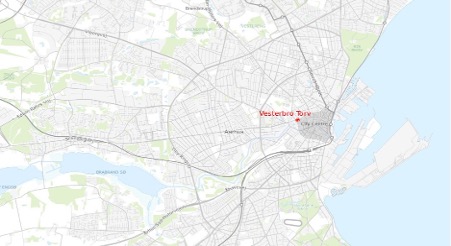
Map of Aarhus:
Map of NBS area and surrounding area:
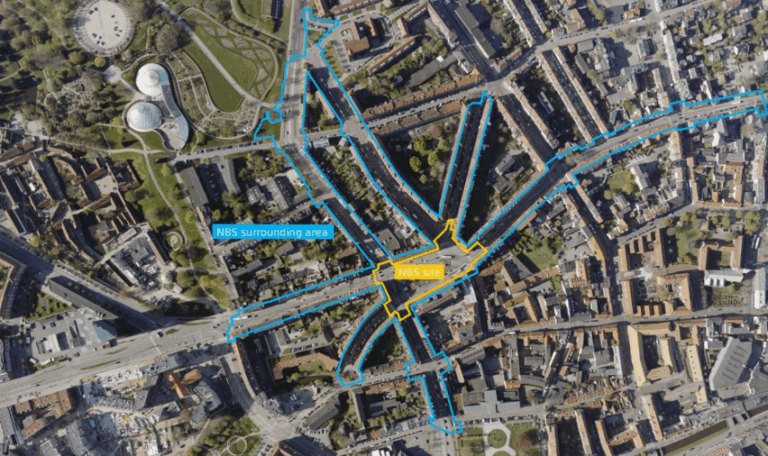
On the northern slope of the river valley lies the Vesterbro district:
The district is characterized by hills, and some streets are among the steepest in Denmark in built-up areas. The district on the hill is located north and northwest of Aarhus C (inner Aarhus) and is one of the most densely populated in Aarhus city centre and consists mainly of older residential buildings (apartments). The Øgade district, which largely characterizes Vesterbro, is mainly a residential district with a cool and cozy local environment, playgrounds and a few shops.
Vesterbro Torv is being reimagined as a vibrant and inclusive urban space that reflects Aarhus’ commitment to sustainability, livability, and community, as the square is now undergoing a transformation into a green, multifunctional public space that invites people to gather, relax, and engage with the city.
Vizualizations of the square after the remodeling:
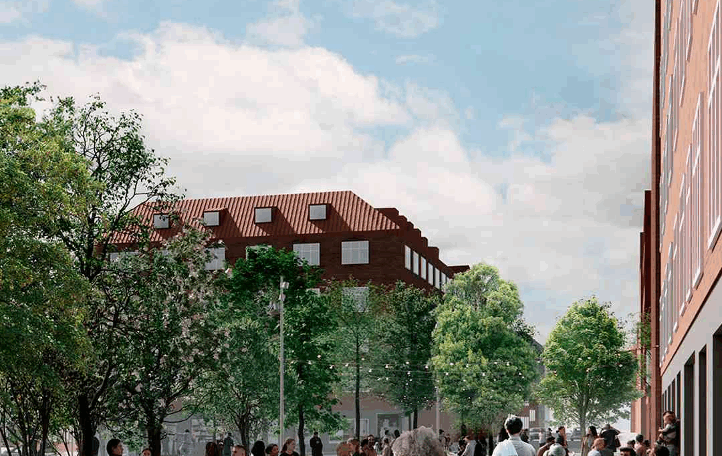

The new Vesterbro Torv is designed to handle up to 1 mio. liters of rainwater.
Instead of channeling water through underground pipes, the square will retain and delay water on the surface. This approach reduces pressure on the sewer system and minimizes the risk of flooding in surrounding streets like Vestergade, Vester Allé, and Museumsgade. [aarhus.dk]
Water will be visibly integrated into the landscape through:
- Rain gardens that collect and filter stormwater.
- Green corridors that guide water across the square.
- Permeable surfaces that allow water to seep into the ground.
Lack of handling of surface water is already a problem at the square:
Therefore, the remodeling project has been designed to collect and delay as much water on the surface as possible to relieve the existing sewer lines. Meaning that the water handling played a central role in the process of developing the architecture of the square and the roads.
It is an attempt to incorporate as much volume as possible on the surface, to delay and partially purify the surface water coming from the city’s surfaces. Several large retention basins will be established upstream, one at the Botanical Garden and two at St. Markus Church Square. These basins can collect a significant amount of water from the Botanical Garden and the northern part of Langelandsgade.
Further down both Hjortensgade, Langelands and Teglværksgade, roadbeds will be incorporated to delay and purify both road and roof water. In the square, larger rain beds collect surface water up to a 20-year event, and in the event of larger events/cloudbursts, the water can be directed from Vesterbro Torv and across and into Janus La Cours Gade, where road beds are also established that can delay and clean the water before it is directed further into the Aarhus River.
