
One task of URBREATH is to participate in conferences related to the URBREATH topics to learn more and to network with other people in the space. During the last months Sara Nyberg and Hans-Peter Egler from the URBREATH consortium partner South Pole got the chance to do this! Here is Sara’s story on what she learned and who she connected with.
*This article was written by Sara Nyberg ,Senior Specialist, Sustainable Infrastructure/Cities /South Pole
On Thursday 4 September 2025 I participated in the Swiss Green Economy Symposium (SGES) in Winterthur, Switzerland. The SGES is the most comprehensive conference on economics and sustainability in Switzerland and started in 2013. During this year’s edition there were more than 2000 participants and 250 speakers.
In the afternoon there were several so called innovation forums (workshops) relevant to URBREATH and South Pole’s focus area in the project (which is innovative financing), such as “Innovative financing: scaling impact through the implementation of public – private – non-profit solutions”, “Sustainable urban development: harnessing synergies for change” and “Biodiversity: Innovation as the key to its sustainable use”. (Original titles in German of the latter two innovation forums: “Nachhaltige Stadtentwicklung: Synergien für den Wandel nutzen” and “Biodiversität: Innovation als Schlüssel für ihre nachhaltige Nutzung”) Since I couldn’t be in two places at the same time, I decided to first participate in the forum on innovative financing, and later in the forum relating to sustainable urban development.
Forum on innovative financing: scaling impact through the implementation of public – private – non-profit solutions
In the forum on innovative financing, Markus Reubi, from the Swiss Federal Department of Foreign Affairs and delegate for Agenda 2030, said that instead of talking about the “funding gap” – we should talk about opportunities for funding instead. I agree that it’s better with a more positive framing! Connected to urban nature-based solutions (NBS), there are definitely many opportunities for funding – as long as the cities are willing to work with it. Furthermore, regarding the funding gap/ concrete funding opportunities, Foteini Katzilaki, Global Institutional Fundraiser at Oikocredit International, mentioned that the SDG funding gap is surpassing 4 trillion dollars annually. In a later round table, which was about making projects investable for private capital, Dr. Marc Nolting, Director Business Development, Deutsche Gesellschaft für Internationale Zusammenarbeit (GIZ), said that 16 trillion USD assets are managed by the Global Investor for Sustainable Development Alliance. This shows that there’s a huge potential for NBS projects to be funded! Dr. Marc Nolting also said that 90-95% of sustainable development projects are not bankable, i.e. they are not designed to create an immediate return on investment. Since many investors want a return on their investment, this needs to be changed, for more projects to get financed. Since NBS projects normally don’t give a return on investment in financial terms, since a tree in a park doesn’t generate money, we need innovative approaches to make NBS projects bankable. Some ideas are to have a kiosk or restaurant in a park, which generates income, or to rent out bikes or perhaps pedal boats.
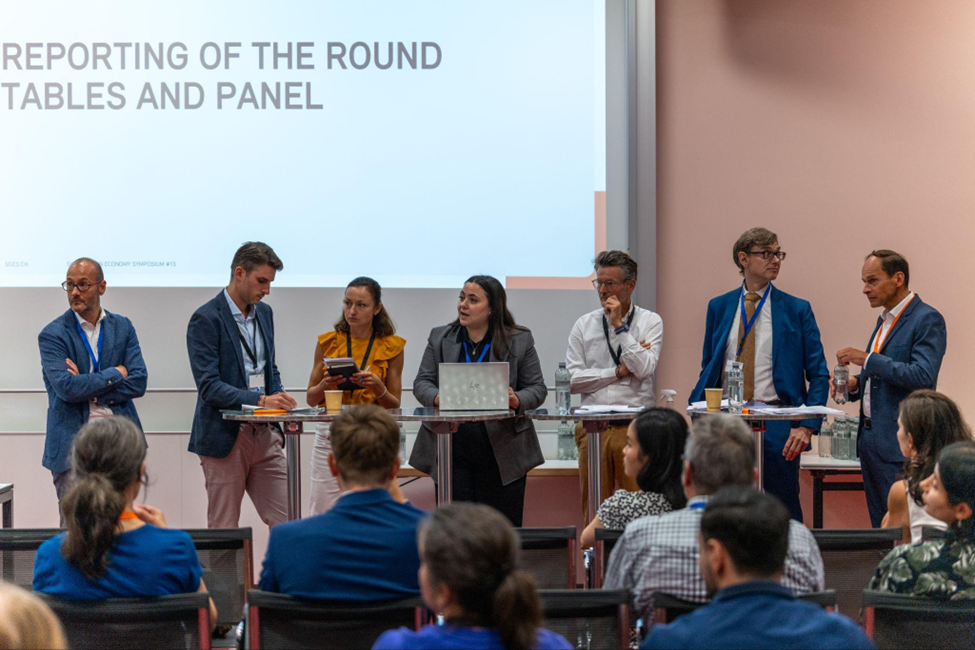
Another topic that was discussed in the round table was the mismatch of ticket sizes of investors to the size of the projects to be invested in. Usually the ticket sizes of investors are rather large – however, in the country the investment needs are rather small. Someone said that under 50 mio it doesn’t make sense to invest – because you have reporting costs, other paperwork, etc. How to tackle this? Several solutions were proposed, such as:
-
Pooling projects & pooling administrative tasks to a larger entity, which can be invested in as a whole
-
Have one partner from the first stage until the end of the project and put people in the centre (especially entrepreneurs). Focus more on relationship building with entrepreneurs and the team, rather than demanding paperwork. If you can’t follow along the whole journey, build a partnership with a partner who can be there from beginning to end.
-
You need different players in the market, where some focus on smaller ticket sizes, for earlier stage projects.
In another presentation of the innovative financing forum, which was about blended finance, the students Hana Gashi and Leonhard Gräf from the University of Liechtenstein shared several strategic insights. Two of them were more related to URBREATH, namely that policy reforms unlock new tools, creating incentives (noting that municipalities can make policy reforms) and that local participation boosts viability. In URBREATH we are working a lot with stakeholder participation, for several reasons, but boosting viability is definitely one benefit.
Forum on sustainable urban development: harnessing synergies for change
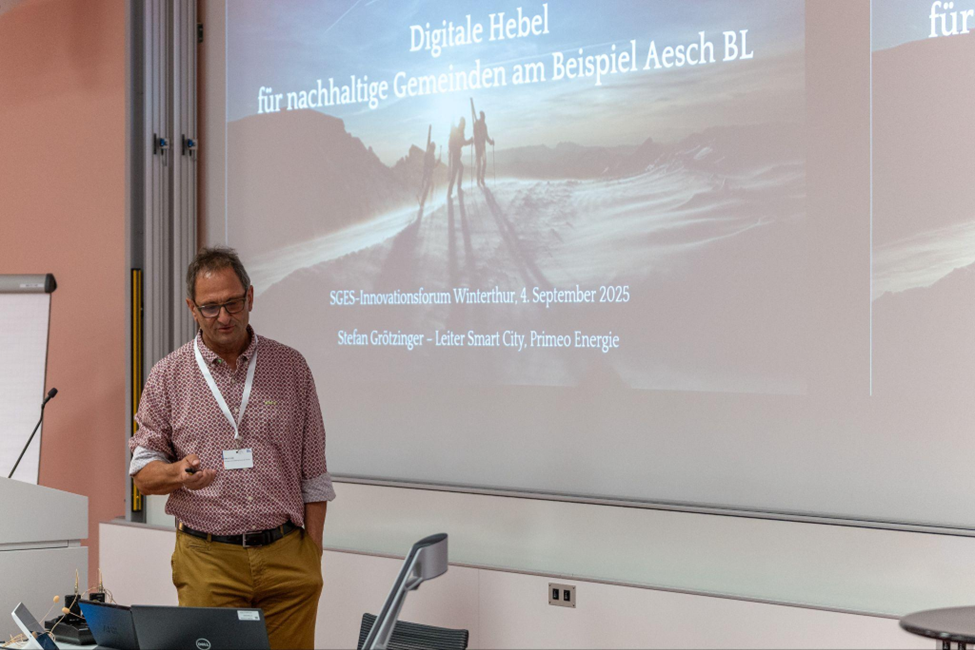
In the forum on sustainable urban development, several inspirational examples were shared, which were related to URBREATH. One example was the smart city pilot project in the town of Aesch in the Kanton Basel-Landschaft in Switzerland. It is using Internet of Things (IoT) and a digital twin for a new parking area. The benefits are for example to know when to remove snow from the parking and to know how many free parking spots there are. The digital twin serves to show data of the smart city for the citizens. In the town, another use case of IoT is data based watering of public green spaces. In URBREATH, smart meters are used in the frontrunner city Cluj-Napoca (Romania), and a digital twin has been created for several cities, e.g. the frontrunner cities Tallinn (Estonia) and Leuven (Belgium). Furthermore, the town of Aesch has several dashboards, which shows data in a clear way for the municipal administration, and to transparently communicate the results and progress made. Aesch – like the URBREATH cities – want to inspire other municipalities and spread their knowledge, to more easily implement the solutions in other places, for an increased positive impact.
Another inspirational example came from Winterthur, and the “Innovationslabor Grüze”. There, they are testing different ground covers and how the water infiltrates, the soil moisture, evaporation, water storage, temperature and precipitation depending on the ground cover. The results are shown on the webpage of the municipality.
Another type of NBS, shared by Andreas Dreisiebner, founder of Grow Solutions (in the audience), is green roofs, which reduce the energy consumption in buildings. It was inspirational to hear that you can have green roofs on bus shelters as well! After the presentations I talked with him, learning that Grow Solutions develops green roofs, which can include rooftop farming, wild bees cottage, stones and “dead” wood on rooftops as well (biodiversity islands). A smart water system can contribute to a cooling effect of the building (top floor) and which is drought resistant.
One speaker in the forum on sustainable urban development said during the panel discussion that piloting and testbeds are important to bring innovation forward. This confirms that the URBREATH approach with pilot cities making projects in pilot sites, and with frontrunner and follower cities, is very good for innovation!

After the events I talked with different participants. Relevant to URBREATH are the companies Agvolution, which develops sensors for soil (moisture) measurement – a KPI that several of the URBREATH cities are measuring – and Quantum Analytics, which is using data, e.g. measuring KPIs of city strategy development and implementation, which is relevant to the URBREATH work with KPIs.
My key takeaways from participating in the forums are that financing challenges for the SDGs can be overcome and that innovative solutions for sustainable urban development are already being implemented – which gave inspiration and hope! If you are also based in Switzerland and are working within sustainability, I would definitely recommend attending the next SGES conference.
Therefore, if you’re working with NBS: keep up the good work! If not: hopefully this can inspire you to promote more NBS in urban environments. Most importantly: connect with others who have already financed and possibly even implemented NBS, to learn from them!